

Views: 0 Author: Site Editor Publish Time: 2026-08-26 Origin: Site


Relying on underspecified power delivery systems in demanding environments introduces severe operational and safety risks. Using inadequate cords for high-draw equipment frequently leads to voltage drops, premature equipment failure, and catastrophic fire hazards. Facility managers and engineers must also consider the legal and financial ramifications of OSHA violations stemming from improper electrical setups. The core problem lies in the ambiguity of the term "heavy duty." In consumer marketing, the phrase is often used as a meaningless buzzword. In strict engineering contexts, it defines precise load capacities, thermal thresholds, and physical resilience required for safe operation.
This technical evaluation guide helps procurement and engineering teams decode complex cable specifications. We will examine how to assess environmental resilience, calculate voltage drop over distance, and select the correct power delivery solution for specific high-demand applications. By understanding the underlying anatomy of these components, you can eliminate guesswork and ensure your infrastructure operates safely under continuous stress.
Professional-grade power delivery separates itself from consumer-grade cords through measurable success criteria. Success in demanding environments is measured by continuous load capacity, thermal stability under stress, and physical durability against mechanical impact. A standard extension cord might survive occasional use with a hand drill. It will quickly melt or short-circuit when tasked with running a commercial compressor or temporary distribution panel on a hot job site.
We see this failure constantly in the field. A contractor grabs a cheap cord from a big-box store, plugs in a heavy-draw tool, and wonders why the breaker trips or the tool motor burns out. The issue is that consumer labels like "heavy duty" carry no regulatory weight. You have to look at the actual printed specifications on the cable jacket to know what you are holding.
Standard household cords typically utilize 16 to 18 AWG wire. These are rated for under 13 amps and feature light thermoplastic insulation designed for indoor, low-impact use. In contrast, an industrial heavy duty cable is engineered for entirely different parameters. These robust cables are often rated for 0.6/1 kV and can handle anywhere from 15A to well over 40A, depending on their cross-sectional area. The insulation is significantly thicker and formulated to resist harsh environmental factors.
Length limitations further differentiate the two categories. Light-duty cords are generally restricted to short runs under 25 feet. Pushing them beyond this distance causes dangerous resistance levels. Heavy-duty variants are specifically engineered to maintain safe voltage over extended commercial distances. They utilize thicker copper conductors to mitigate resistance and prevent equipment starvation.
Understanding the primary categories of heavy-duty cables helps narrow down the selection process based on the use case. You do not want to use a rigid direct-burial cable for a portable welding rig, nor do you want a highly flexible portable cord permanently wired into a conduit.
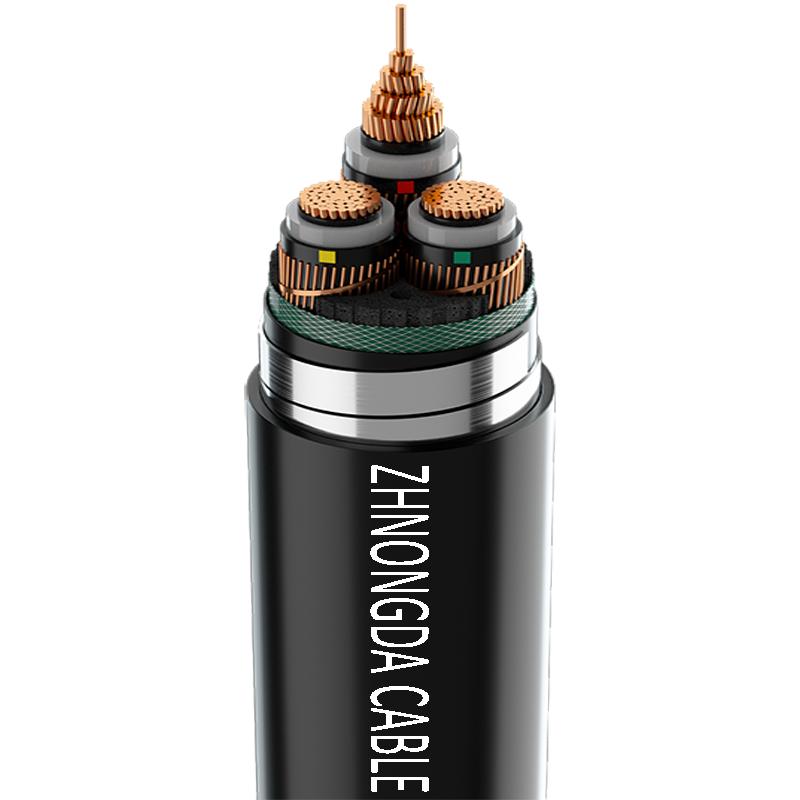
Evaluating a power cable requires looking beneath the outer jacket. The internal construction dictates how much current the cable can carry, how well it bends, and how long it will survive in a dynamic environment. You cannot judge a cable by its outer diameter alone, as some manufacturers use thick, cheap insulation to hide dangerously thin conductors.
The American Wire Gauge (AWG) system operates on an inverse relationship. The lower the AWG number, the thicker the wire. Thicker wires have less electrical resistance, allowing them to carry more current safely without generating excessive heat. Standard thresholds for demanding applications include 14 AWG (rated for 15A), 12 AWG (rated for 20A), and 10 AWG (rated for 30A). For heavy machinery or large distribution panels, you will frequently encounter 8 AWG, 6 AWG, or thicker multi-pole configurations.
| AWG Size | Max Amperage (Typical) | Common Applications | Typical Connector |
|---|---|---|---|
| 14 AWG | 15 Amps | Hand tools, portable lighting, light compressors | NEMA 5-15 |
| 12 AWG | 20 Amps | Table saws, heavy duty vacuums, small welders | NEMA 5-20 |
| 10 AWG | 30 Amps | Generators, large air compressors, RV power | NEMA L5-30 / TT-30 |
| 8 AWG | 40 Amps | Industrial machinery, large distribution panels | Hardwired / Pin & Sleeve |
| 6 AWG | 55 Amps | Heavy temporary power, large mobile generators | Cam-Lok / Hardwired |
Pure copper is the absolute standard for any high load power cable. While copper-clad aluminum (CCA) is cheaper and lighter, it has higher electrical resistance and becomes brittle under physical stress. Pure copper ensures maximum conductivity and thermal stability. If you use CCA in a high-vibration environment, the aluminum core will eventually micro-fracture, leading to a localized hot spot and a potential fire.
Strand count also plays a vital role. Solid copper wire is rigid and prone to snapping if bent repeatedly. High strand counts improve flexibility and prevent internal breakage in dynamic environments like robotics or portable tools. A welding cable, for instance, uses thousands of hair-thin copper strands to remain completely limp and flexible while carrying hundreds of amps.
Internal fillers such as jute or paper, combined with shielding, reinforce the cable against twisting, pulling forces, and mechanical stress during deployment. When a worker yanks a cord out of a tangled pile, these fillers absorb the tensile stress, protecting the copper conductors from stretching or breaking.
The letters printed on a cable jacket provide a standardized map of its capabilities. Common designations include 'S' for Service (indicating a 600V rating), 'O' for Oil-resistant, and 'W' for Weather or Water-resistant. A jacket marked SOOW, for example, is a 600V service cord resistant to oil on both the inside insulation and outside jacket, as well as weather-resistant.
| Letter Code | Meaning | Field Application |
|---|---|---|
| S | Service Grade (600 Volts) | Heavy industrial use, hard usage environments. |
| J | Junior Service (300 Volts) | Lighter duty, standard commercial applications. |
| E | Elastomer (Thermoplastic) | Lighter weight, good for moderate temperatures. |
| O | Oil-Resistant Outer Jacket | Garages, machine shops, automotive plants. |
| OO | Oil-Resistant Inside & Outside | Petrochemical plants, heavy machining centers. |
| W | Weather/Water Resistant | Outdoor construction, marine environments. |
Material choices generally fall into two categories. Thermoset rubber-based compounds (like CPE or EPDM) are highly flexible, melt-resistant, and perform exceptionally well in extreme cold or heat. Thermoplastic PVC-based compounds (like SJTW) are lighter and generally less expensive. They become stiff in freezing temperatures and can deform under high heat. If you are working outside in a northern winter, a PVC cord will freeze solid like a pipe, while a rubber cord will remain flexible.
The point where the cable meets the plug is the most common failure point. Molded connectors are permanently fused to the jacket, offering excellent water resistance but zero repairability. Mechanically assembled connectors allow for field repairs but require careful maintenance to ensure a watertight seal. Regardless of the type, heavy-duty strain relief collars are critical. These collars distribute the bending stress away from the termination points, preventing wire separation and dangerous arcing.
Electrical resistance increases with distance. Failing to account for this physical reality is a leading cause of equipment damage on job sites. You cannot simply chain three 50-foot cords together and expect your equipment to run properly.
As current travels through a conductor, the natural resistance of the copper causes a drop in voltage. If a tool requires 120V to operate efficiently, a long, undersized cable might only deliver 110V to the motor. A voltage drop of 5% or greater forces motors to draw more amperage to compensate. This causes them to overheat and eventually fail. Sensitive electronics may simply refuse to power on or suffer erratic behavior.
Consider a 15-amp air compressor. If you plug it directly into a wall receptacle, it gets the full 120 volts. If you run it at the end of a 100-foot 14 AWG cord, the voltage might drop to 108 volts. The compressor motor will struggle to start, run excessively hot, and the internal windings will eventually burn out. You have just destroyed a thousand-dollar piece of equipment to save twenty dollars on a proper cord.
Scaling the wire gauge with the required length is mandatory to maintain commercial load capacity. A 15-amp load can safely run on a 14 AWG cable if the distance is only 25 feet. However, if you need to push that same 15-amp load 100 feet, the resistance of the 14 AWG wire becomes too high. You must upgrade to a 10 AWG cable to keep the voltage drop within safe limits.
| Amperage Load | 25 Feet | 50 Feet | 100 Feet | 150 Feet |
|---|---|---|---|---|
| 10 Amps | 16 AWG | 14 AWG | 12 AWG | 10 AWG |
| 15 Amps | 14 AWG | 12 AWG | 10 AWG | 8 AWG |
| 20 Amps | 12 AWG | 10 AWG | 8 AWG | 6 AWG |
| 30 Amps | 10 AWG | 8 AWG | 6 AWG | 4 AWG |
Selecting the right cable involves balancing necessary length against increased weight and higher procurement costs. A 100-foot 10 AWG cable is significantly heavier and bulkier than a 25-foot version. Over-specifying length when it isn't needed wastes capital and makes daily deployment physically taxing for workers. Buy the length you actually need for the job, plus a small margin for routing. Do not buy a 100-foot cord for a 20-foot run just to have extra length, as you will be fighting the weight and the voltage drop unnecessarily.
Electrical capacity is only half the equation. A durable power cable must survive the physical realities of its deployment environment. A cable that works perfectly in a clean, climate-controlled server room will be destroyed in days on a concrete construction site.
Active job sites and manufacturing floors subject cables to constant abuse. Forklifts drive over them, tools drop on them, and workers drag them across rough concrete. Jacket thickness and material density protect the internal conductors from being crushed or exposed. Thermoset rubber jackets excel here, absorbing impacts and resisting cuts better than standard PVC. If a forklift runs over a cheap PVC cord on a cold day, the jacket will shatter. A heavy-duty rubber jacket will compress and rebound, keeping the internal conductors safe.
In automotive, petrochemical, or machining environments, standard thermoplastic jackets degrade rapidly when exposed to solvents, cutting fluids, or motor oil. The jacket swells, cracks, and eventually exposes the live wires. Cables used in these sectors must carry specific oil-resistance ratings (like the 'O' or 'OO' in SOOW) to ensure the compound remains stable under chemical attack. We have seen standard cords turn into sticky, degraded messes after just a few weeks resting in a puddle of machine coolant.
Outdoor construction and generator use require cables that can handle extreme weather. Cables must be UV resistant to prevent sunlight from embrittling the jacket over time. Extreme temperature ratings are necessary. A proper heavy-duty cord will remain flexible at -40°C and resist melting at continuous operating temperatures up to 90°C. If you are running temporary power for a winter construction project, you need a cord that won't fight you when you try to unroll it in the snow.
Different industries require specific cable configurations to handle their unique operational stresses. You must match the cable's physical and electrical properties to the exact demands of the job.
Connecting a mobile generator to a distribution panel requires multi-conductor thick-gauge cables. Configurations like L14-30P to L14-30R utilize locking connectors to prevent accidental disconnects. These cables feature heavy insulation and are strictly required for stable, high-amperage current transmission across outdoor environments. You cannot afford a loose connection when transmitting 30 amps of 240-volt power across a muddy field.
Industrial machinery introduces high vibration and repetitive motion. Robotics and automated tracks require continuous-flex cables. These specialized cables use ultra-fine copper stranding and unique internal lubricants to withstand millions of bending cycles without the conductors snapping or the jacket tearing. Standard stranded wire will fatigue and break under these conditions, leading to intermittent power failures that are incredibly difficult to troubleshoot.
In data centers and professional audio-visual setups, stable performance is critical. These environments prioritize precise voltage delivery to protect sensitive, high-value equipment. Locking connectors, heavy shielding against electromagnetic interference (EMI), and strict adherence to length-to-gauge ratios ensure uninterrupted uptime. A voltage sag in a server rack can cause data corruption, making the quality of the power delivery system just as important as the servers themselves.
Deploying power infrastructure without verifying regulatory compliance exposes facilities to severe liability. You are not just risking equipment damage; you are risking lives and massive fines.
Workplace safety mandates strict adherence to established standards. UL (Underwriters Laboratories) listings and CSA (Canadian Standards Association) certifications prove that a cable has been independently tested for thermal stability and fire resistance. Adherence to OSHA regulations and National Electrical Code (NEC) guidelines dictates how these cables can be legally deployed, routed, and maintained. OSHA inspectors will actively look for unrated, damaged, or improperly routed cables during site visits.
Even the best cables fail if implemented poorly. Common risks include:
Establish strict inspection protocols. Before deployment, workers must check for jacket tears, bent prongs, and heat discoloration around the plugs. Implement routine maintenance schedules to retire cables that show signs of internal wire breakage or degraded insulation. If you see exposed copper or a plug that looks melted, cut the ends off and throw the cable in the trash immediately.
A: A true heavy duty power cable typically ranges from 14 AWG to 10 AWG for portable cords. For permanent industrial applications or high-output generators, 8 AWG or thicker is standard to handle continuous high-amperage loads safely.
A: Increased length increases electrical resistance, causing voltage drop. To compensate for this drop and maintain safe load capacity at the equipment end, you must use a thicker gauge wire for longer distances.
A: The letters decode the cable's service grade and environmental resistance. 'S' stands for Service (600V), 'J' for Junior Service (300V), 'E' for Elastomer, 'O' for Oil-resistant, and 'W' for Weather/Water-resistant.
A: No. Standard extension cords pose severe fire and equipment damage risks. You must use heavily insulated, high-gauge generator-specific cables to safely transmit high-amperage power to distribution points.
A: SOOW features a 600V rating and a thermoset rubber jacket, making it highly durable and flexible in extreme conditions. SJEOOW has a 300V rating and uses a thermoplastic elastomer, making it lighter but less resilient to extreme heat.
A: Heat indicates excessive electrical resistance. The cable is likely undersized for the amperage load, excessively long for its gauge, or dangerously coiled while under load, which traps heat and causes induction.
 简体中文
简体中文 

