

Views: 0 Author: Site Editor Publish Time: 2025-10-30 Origin: Site


Underwater communication and navigation systems are essential to the operation of a variety of marine industries, from commercial shipping and offshore oil rigs to scientific research and deep-sea exploration. These systems rely heavily on advanced technologies that need to function under extreme conditions, including high pressures, saltwater exposure, and challenging temperature variations. To ensure these systems operate efficiently and reliably, the use of specialized marine cables becomes indispensable.
Marine cables, particularly those designed for underwater use, serve as the backbone for connecting underwater communication devices, sensors, and navigation systems. Without these cables, the smooth functioning of vessels, submarines, and underwater platforms would be significantly compromised. In this article, we will explore the critical role marine cables play in underwater communication and navigation, the different types of cables used, and how they help improve the safety and efficiency of marine operations.
Before diving into the specifics of marine cables, it is important to understand the two primary functions that they support in underwater environments: communication and navigation.
Underwater communication is critical for the safe operation of vessels and submarines, as well as for remote underwater exploration. Unlike traditional radio waves, which cannot travel through water, communication in underwater environments relies on acoustic waves, optical signals, or wired systems, depending on the application. Cables that support communication systems provide the physical infrastructure that connects equipment like sonar systems, underwater microphones, and communication devices on vessels or platforms.
Navigation systems are used to track the position of underwater vehicles, such as submarines or remotely operated vehicles (ROVs), and to guide their movements. These systems rely on a combination of sonar technology, GPS (for surface navigation), and precise depth sensors. Marine cables ensure that data from these sensors and systems can be transmitted effectively, enabling operators to make informed decisions about the positioning of their vessels or equipment.
Marine cables are essential to the functioning of both underwater communication and navigation systems. These cables facilitate the transmission of data, power, and control signals between equipment on the sea surface and those operating at depth. Marine cables are designed to endure extreme pressures, resist corrosion from saltwater, and maintain signal integrity over long distances.
Acoustic waves, commonly used for underwater communication, rely on special sensors and transducers placed along the cables to transmit and receive sound waves. The marine cables serve as the medium to carry power and data to these sensors, enabling the transmission of audio or data signals to be sent over long distances.
In some cases, cables are used for communication between submarines and surface ships, allowing for real-time data sharing even in challenging conditions. These cables must be equipped with the ability to withstand the extreme pressure of deep water while maintaining a reliable connection.
Applications:
Sonar systems used for underwater navigation.
Acoustic data transmission for scientific research.
Underwater communication between ROVs and surface stations.
Cable Features:
High flexibility to accommodate the movement of vessels and ROVs.
Reliable insulation to prevent water ingress and ensure signal clarity.
Durable outer sheaths to protect against the abrasive underwater environment.
Many underwater communication and navigation devices require a continuous power supply. Marine cables are used to deliver this power from the surface or from an underwater platform to the operating devices, such as sonar transducers, acoustic modems, and communication receivers.
These cables must be engineered to supply stable power even under extreme pressure, and they must be resistant to the damaging effects of saltwater. Additionally, some marine cables used for power transmission are designed to integrate with fiber optic cables, which are used for high-speed data transmission, providing both power and communication through a single integrated cable solution.
Applications:
Powering sonar systems and underwater sensors.
Providing energy to ROVs and underwater vehicles.
Enabling data transfer for remote underwater cameras.
Cable Features:
High insulation to prevent electrical shorts caused by moisture.
Tough outer sheaths resistant to crushing and physical damage.
Capability to transmit both power and data through combined power and signal cables.
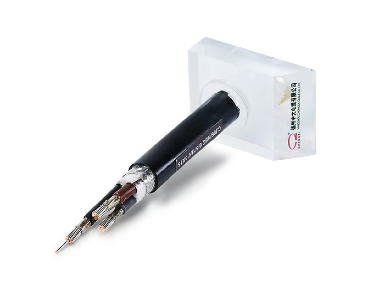
In modern underwater communication and navigation systems, fiber optic cables have become the preferred choice for data transmission due to their high speed and bandwidth. Fiber optics use light to transmit data, allowing for fast and efficient communication over long distances without signal degradation. These cables are ideal for transmitting real-time data, such as navigation coordinates, depth measurements, and sonar data.
Fiber optic cables are typically used in conjunction with other types of marine cables to provide a complete communication solution. They can also be used for powering remote equipment, such as ROVs, making them indispensable in underwater exploration and research.
Applications:
High-speed data transmission for communication with submerged vessels.
Real-time monitoring of underwater activities and equipment.
Data transmission for underwater imaging and sonar systems.
Cable Features:
Superior data transfer speeds.
High resistance to corrosion and water damage.
Lightweight and flexible design, making them ideal for use in remote underwater locations.
Marine cables used for underwater communication and navigation must be able to withstand harsh environmental conditions, including high water pressure, extreme temperatures, and saltwater corrosion. Cables that operate at great depths must be designed to endure the immense pressure of deep-water environments, which can exceed hundreds or even thousands of pounds per square inch.
Additionally, these cables need to have strong outer insulation to prevent damage from physical impacts, such as those caused by underwater debris or anchor cables. The outer protective layer of the cables is usually made from materials such as polyurethane or polyethylene, which are resistant to both chemical and physical wear.
Applications:
Subsea power and communication systems.
High-pressure underwater sensor networks.
Equipment used in underwater exploration, such as robotic arms and drones.
Cable Features:
High resistance to physical damage and abrasion.
Protective layers designed for deep-sea applications.
Anti-corrosion properties to withstand saltwater exposure.
Selecting the right marine cable for underwater communication and navigation systems involves several factors, including environmental conditions, power requirements, and the type of system being used. Some key considerations include:
Marine cables must be capable of withstanding the unique challenges of the underwater environment. They should be resistant to corrosion from saltwater and chemicals, as well as to mechanical wear and tear from underwater movement and physical stress. Choose cables with robust insulation and protective coatings to ensure their longevity and reliability.
The integrity of data transmission is crucial for both communication and navigation systems. Whether using fiber optics or traditional electrical cables, it is essential to choose cables that can maintain high signal quality over long distances and under challenging conditions. Shielded cables can help protect against interference and maintain data clarity.
For deep-water applications, cables must be designed to handle the immense pressures of the deep sea. These cables should be rated for the maximum depth they will be used in and should have pressure-resistant materials to prevent crushing and deformation.
Underwater cables often need to be flexible to accommodate movement, especially in ROVs and submarines. Flexible cables can bend and twist without breaking or damaging the internal conductors. It is also important to ensure that the cable’s outer sheath is tough enough to withstand abrasion from underwater currents, debris, and physical impacts.
Marine cables play a critical role in ensuring the success of underwater communication and navigation systems. They provide the vital connection between surface vessels and underwater vehicles or equipment, ensuring the safe and efficient operation of complex maritime systems. Whether for powering sonar devices, transmitting high-speed data via fiber optics, or withstanding the pressures of deep-sea exploration, marine cables are a fundamental part of the underwater infrastructure.
For those seeking high-quality marine cables designed for reliable and long-lasting underwater performance, Yangzhou Zhongda Cable Co., Ltd. offers a range of cables that meet industry standards. Their cables are engineered to endure the harsh conditions of the marine environment, providing excellent performance in both communication and navigation systems for a wide range of applications.
 简体中文
简体中文 

